

STEP 1
Map the fixed decisions
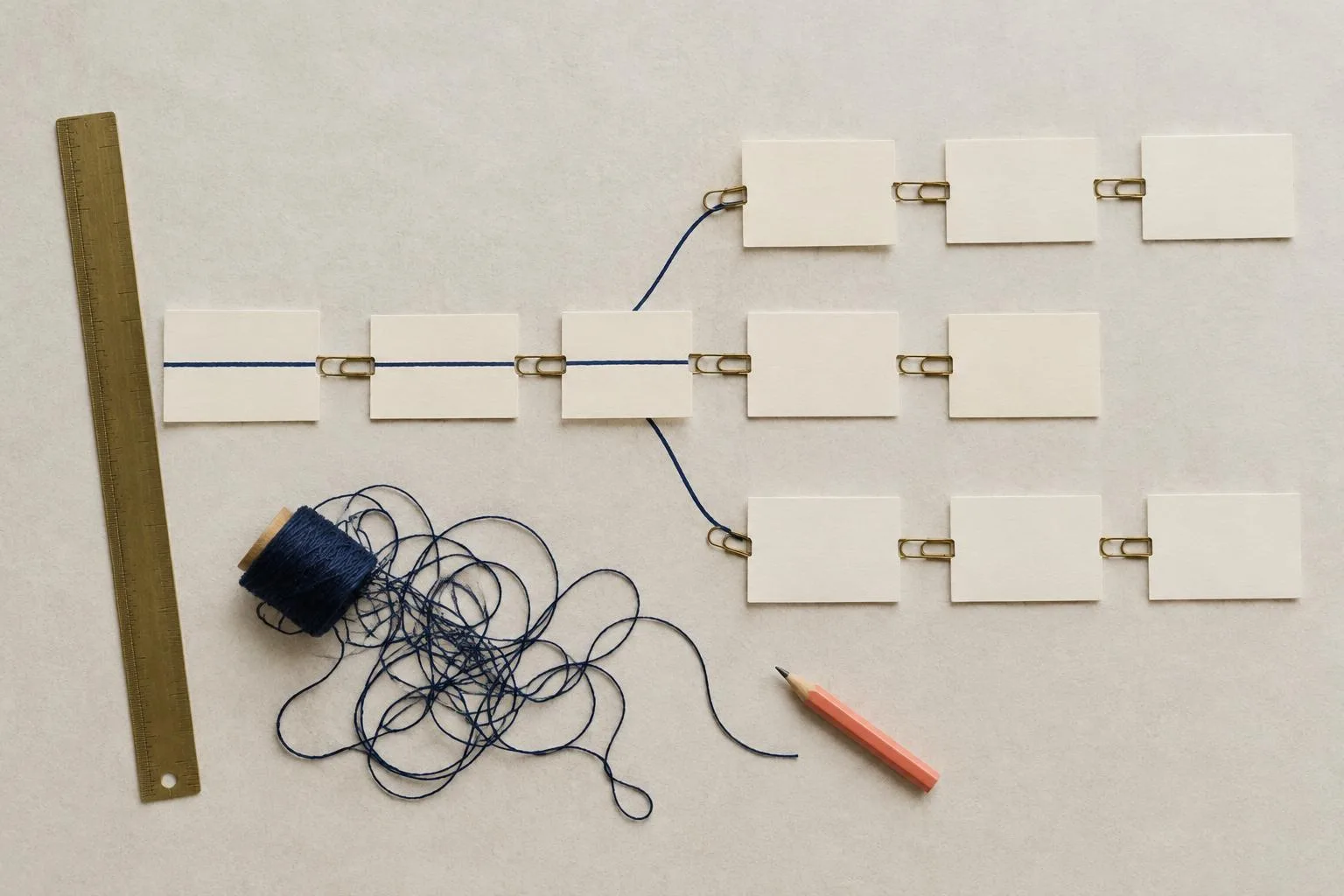
List inputs, branches, tools, approvals and outputs. Mark decisions whose correct behavior can be specified in advance.
Myth Busters
Repeatability makes a case for automation. Agents earn their place when the work also requires adaptive, non-deterministic reasoning.
THE MYTH
“Every repeatable workflow needs an AI agent.” Repeatability is a good reason to consider automation. It is not, by itself, a reason to make that automation agentic. A fixed process can remain fixed; an agent becomes useful when the work requires interpretation, changing choices, or a route that cannot sensibly be specified in advance.
The distinction between ordinary workflow automation and agentic execution
How to decide whether non-deterministic reasoning belongs in a repeatable process
The appealing version of the agent story is simple: find something people do repeatedly, give the job to an AI agent, move on. But repetition answers only the first architectural question. It tells you there may be something worth automating. It says surprisingly little about what kind of automation should do it.
Consider the distinction between a process and a decision. A process might receive a request, call an API, check a known condition, call another API and return the result. Every branch may already be describable. Adding probabilistic reasoning to that sequence does not become necessary merely because the sequence happens repeatedly.
A practitioner in r/AI_Agents described essentially that fixed API sequence as more reliable and easier to debug as a normal workflow. The same builder said an agent makes more sense when the system must choose tools, decide their order and adapt to results. That is practitioner experience, not a controlled benchmark, but the boundary is useful.
The myth is too absolute. Some repeatable tasks contain ambiguity; others do not. Some require judgment over language; others need an exact rule followed consistently. “Repeatable” describes a pattern. “Agentic” describes an execution approach. They are different properties.
A better test starts with what can be specified beforehand. Conditions, splits, loops, delays, transformations, API requests and approvals can all handle work without asking a model to infer the next move. When desired behavior can be expressed explicitly, conventional orchestration remains a valid architecture.
OpenOps provides a documented example. Its workflow documentation lists more than 120 actions, including conditions, splits, loops, delays, approvals, API operations and data transformations. An AI Step, which sends prompts to an LLM, appears alongside those actions rather than replacing them.
The same documentation includes human intervention and identifies some cloud-changing actions as high risk. That illustrates another architectural issue: automation is not only about producing an answer. A workflow may also need explicit decisions about where execution pauses, who approves an action and what happens around consequential operations.
None of this proves deterministic workflows are universally superior. It establishes the narrower point: AI and conventional orchestration can coexist. The presence of AI somewhere in a system does not require transferring every predictable decision to a model.
Amit Saar, OpenOps co-founder and CEO, makes the distinction explicitly in a LinkedIn post. His shorthand for deterministic work is “same inputs = same outputs.” In his formulation, ordinary automation can handle that case; he associates agents with LLM orchestration, non-deterministic workflows and measurable ROI. It is a founder’s position, not an independent standard.
Practitioner discussion points in a similar direction. One r/AI_Agents builder separates a fixed API sequence from work where the system must choose tools and their order, then adapt after seeing results. A second poster asks why an organization would replace what they characterize as a cheap, working deterministic process with probabilistic execution.
Those Reddit posts should not be stretched into comparative performance data. They do not establish that deterministic workflows are always cheaper or more reliable. They provide practitioner perspectives on a practical design concern: adaptive choice can be a reason to consider an agent; repetition alone is not.
That distinction preserves the legitimate case for agents. Inputs can be ambiguous or language-heavy, and the appropriate tool or sequence may depend on intermediate results. In those cases, a process can be repeatable while its route remains uncertain. That uncertainty is the more relevant architectural signal.
What should determine whether a repeatable process becomes agentic?
If a task happens repeatedly, an AI agent is the natural next stage of automation.
Repetition supports automation. Agentic execution becomes more defensible when the work also requires interpretation, adaptive tool choice or a route that cannot be fully specified beforehand.
Start with the smallest decision, not the biggest AI ambition. Draw the process as it operates: inputs, transformations, branches, external calls, approvals and outputs. Then mark only the places where the correct next action genuinely cannot be specified using the information and rules available beforehand.
This avoids a false binary. A workflow can be mostly deterministic and still use an LLM for a language-heavy interpretation step. Conversely, an agent can invoke deterministic tools. The useful question is not which grand label fits the system. It is where uncertainty actually belongs.
There is an important exception: a rule can be possible to encode yet impractical to maintain because inputs contain too many meaningful variations. That can justify testing agentic reasoning. The test still needs boundaries: define the outcome, observe failures and decide where review or a safe stop belongs.
STEP 1
List inputs, branches, tools, approvals and outputs. Mark decisions whose correct behavior can be specified in advance.
STEP 2
Keep predictable execution deterministic. Put agentic reasoning where interpretation, tool choice or sequencing genuinely needs to adapt.
STEP 3
Measure the agentic portion against a defined outcome. Add review, failure handling and a safe path for uncertain or high-risk actions.
There is no architectural prize for maximizing the number of decisions delegated to a model. The useful goal is a system whose behavior matches the problem. For known inputs, explicit conditions and routine integrations, straightforward orchestration may fit. For ambiguity and changing routes, model reasoning may belong exactly where those capabilities matter.
The resulting architecture can be hybrid. Fixed controls can surround a probabilistic step; an agent can call predictable tools; approvals can sit between model output and consequential action. OpenOps’ documented combination of conventional actions, an AI Step and human intervention illustrates that structural possibility without establishing that any particular mixture is universally best.
This framing makes evaluation less fuzzy. Instead of asking whether a workflow is modern enough to deserve an agent, ask what capability the agent supplies. If the answer is adaptive interpretation or decision-making that explicit rules cannot reasonably capture, there is something concrete to test. If the answer is simply repetition, there is not.
The technologies will keep changing, but the architectural question is steadier: which decisions need probabilistic reasoning, and which benefit from being explicit? Repeatable work can sit on either side of that line. Frequency does not settle it.
06 THE VERDICT
BUSTED
BUSTED: Repeatable does not mean agentic.
KEEP READING
GOT A MYTH?